Friday, April 20, 2012

How do You Solve a Problem Like the Falklands?


The Falklands rhetoric that's made-up hundreds of column inches over the past few months continues unabated, yet the rhetoric from both sides remains unabated.  This article from the Argentine Ambassador to the UK does a good job of regurgitating false rhetoric and casually omitting history to justify the Argentine position.  
Frankly all that is irrelevant though; the current population has lived there continuously for almost 180 years, and their wishes must come first if we are to be truly post-colonial.
The Ambassador is right in saying the UK should negotiate, I agree and think the government is silly for not doing so.  Cameron is foolishly failing to show alter his position while Argentine President Christina Kirchner steadily works to diplomatically isolate him on the issue.
It is time for David Cameron to call her bluff.  Cameron should call for a highly publicised UN administered negotiation on the issue, where Cameron, Kirchner, and the Chief Executive of the Falklands can sit down and discuss the issue.  Surely as a representative democratically elected by the people of the Falklands, the Chief Executive should be present, it is only consistent with Argentina's stated desire to not take away the Britishness and the way of life of the 3,000 inhabitants of the islands.  I am sure the UN would support this.  Cameron should then open this meeting by calling on Argentina and the UN agree that no deal can be reached without the approval of the Falklands executive.  This is the best way to outflank Kirchner; she cannot disagree without appearing imperialist, and she cannot agree without losing the the argument.
However things go Cameron needs to accept that to end the issue some sort of negotiation must take place.  Whatever shape these negotiations take, the Falklands should have their own separate delegation and no agreement should exist without their agreement.  That is democracy, that is justice, and that is what Argentina should be pushing for.

Tuesday, April 17, 2012

UKIP on Third, but what does it mean?

UKIPper's across the twitter-sphere where in full celebration last night as the yougov daily tracker showed UKIP in third place, beating the Lib-Dems, for the first time ever in a General election voting intention poll.


UKIP members are right to celebrate this event, a watershed in the party's history and a result they all hope to repeat many times.  It is however important they do not over hype the relevance of this.  They could come in third across several more polls or they could fall back again just as easily.  It is important to note that two other polls came out yesterday, neither showing them in third place, with populus showing roughly a 4% figure.


But the underlying trend is very good for UKIP, the party is up from a month ago and even further up from two months ago.  Support is widening and media coverage is increasing.  UKIP now needs to focus on bringing younger voters into the fold.  Polling figures show the proportion of under 40 voters who are uncommitted is much higher than the proportion of over 40 voters who are uncommitted.  The under 40's is coincidentally a clear weak point for UKIP.  Bringing these voters into the fold is key for cementing UKIP as the third party in British politics.


Finally, we must recognize that an opinion poll is really meaningless in itself.  Election results are all that matters and an increase in polling results increases expectations.  UKIP must perform well in this round of local elections, a few dozen gains is an absolute must, and the same must be repeated next year and the year after.  The party must pick out target areas and build a few strongholds across the nation.  If UKIP can gain control of a council or two at district level or above, and become a major presence in a few more, the party will be in good standing for the next general election.


Nigel Farage is correct when he says, "This isn't some flash in the pan, this is 20 years of hard work which we will continue."  The Lib-Dems still massively outnumber UKIP in councillors and of course in parliament.  The hard work must continue, and the party activists must work even harder to truly establish UKIP as the third party in British politics.

Friday, April 13, 2012

Legalise it.

So this November the American state of Washington will have a referendum on whether or not to legalise marijuana.  Initiative 502 will make it legal for Adults to carry small quantities of marijuana and will regulate the production and sale of the drug in a similar way that hard liquor is regulated.

As a Libertarian, I believe the government has no right to tell me whether or not I can smoke weed.  Yet legalisation is about more than stoners’ rights: legalising and regulating the marijuana market would take profits away from violent drug cartels while providing a massive windfall for government coffers.  Deficit? Bye Bye.

Hopefully this initiative will make it succeed in Washington state, and hopefully the UK will follow the likes of Holland in taking this progressive step.

Campaigning for UKIP

This afternoon I shall be out and about in East Neuk, campaigning for Michael Scott-Hayward's re-election to FIfe council.  Mike has been involved in Fife local politics for 25 years.  He is Chairman of UKIP Scotland and a tireless campaigner for local issues.


If you would like to help Mike or learn more about UKIP, feel free to contact either Mike or me, and spread the word!


you can read his manifesto here:
http://mikescotthayward.blogspot.co.uk/2012/04/council-elections.html

Monday, March 19, 2012

How Our Taxes Work

Saw this on the telegraph from one very clever poster


"Mr Clegg’s rise in tax allowances will disproportionately help the better
off"
We frequently see this sort of statement from journalists made as a criticism of any proposed tax cut.  Those making it are either being intellectually dishonest or are simply incapable of understanding how the tax system works.  Tax cuts will always give bigger tax breaks to the better off for the simple reason that they pay more tax in the first place (and of course every tax rise will disproportionately hurt the better off but doesn't seem to get pointed out very often)  What is important is that tax cuts help the poorer relatively more than they help the better off - the family who are struggling to make ends meet are going to appreciate an extra £10 a week far more than the family who has plenty of disposable income already will appreciate the extra £100 a week.
For a (slightly) humorous explanation of how the tax system works, try the following:
Suppose that every day, ten men go out for beer and the bill for all ten
comes to $100. If they paid their bill the way we pay our taxes, it
would go something like this:
The first four men (the poorest) would pay nothing.
The fifth would pay $1.
The sixth would pay $3.
The seventh would pay $7.
The eighth would pay $12.
The ninth would pay $18.
The tenth man (the richest) would pay $59.
So, that's what they decided to do.
The ten men drank in the bar every day and seemed quite happy with the
arrangement, until one day, the owner threw them a curve. 'Since you are
all such good customers,' he said, 'I'm going to reduce the cost of
your daily beer by $20.' Drinks for the ten now cost just $80.
The group still wanted to pay their bill the way we pay our taxes so the
first four men were unaffected. They would still drink for free.
But what about the other six men - the paying customers? How could they
divide the $20 windfall so that everyone would get his 'fair share?'
They realized that $20 divided by six is $3.33. But if they subtracted
that from everybody's share, then the fifth man and the sixth man would
each end up being paid to drink his beer.
So, the bar owner suggested that it would be fair to reduce each man's
bill by roughly the same amount, and he proceeded to work out the
amounts each should pay.
And so:
The fifth man, like the first four, now paid nothing (100% savings).
The sixth now paid $2 instead of $3 (33%savings).
The seventh now pay $5 instead of $7 (28%savings).
The eighth now paid $9 instead of $12 (25% savings).
The ninth now paid $14 instead of $18 (22% savings).
The tenth now paid $49 instead of $59 (16% savings).
Each of the six was better off than before. And the first four continued
to drink for free. But once outside the restaurant, the men began to
compare their savings.
'I only got a dollar out of the $20,'declared the sixth man. He pointed to the tenth man,' but he got $10!'
'Yeah, that's right,' exclaimed the fifth man. 'I only saved a dollar, too.
It's unfair that he got ten times more than I got' 'That's true!!'
shouted the seventh man. 'Why should he get $10 back when I got only
two? The wealthy get all the breaks!'
'Wait a minute,' yelled the first four men in unison. 'We didn't get anything at all. The system exploits the poor!'
The nine men surrounded the tenth and beat him up.
The next night the tenth man didn't show up for drinks so the nine sat
down and had beers without him. But when it came time to pay the bill,
they discovered something important. They didn't have enough money
between all of them for even half of the bill!
And that, ladies and gentlemen, journalists and college professors, is
how our tax system works. The people who pay the highest taxes get the
most benefit from a tax reduction. Tax them too much, attack them for
being wealthy, and they just may not show up anymore. In fact, they
might start drinking overseas where the atmosphere is somewhat
friendlier.


Credit to simoncarter for this.

Wednesday, March 7, 2012

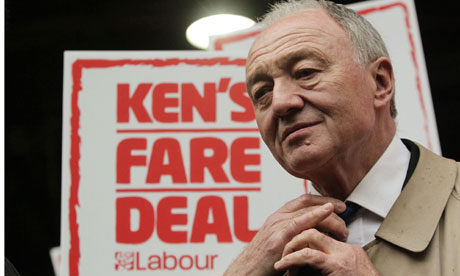
Ken Livingstone - why is such a poisonous man the Labour candidate in London?

Two big stories in the news today regarding the race to be the next mayor of London, neither are good for Ken.

Firstly the question of Ken's tax avoidance.  Labour's ever vocal champion of the poor has been smacked around recently the way he has organised his finances.  Ken has avoided paying the 50p top rate of tax - which he earnestly supports - by paying himself through a front company Ken is managing to get away with the much lower corporate rate, about 20 percent.  Mehdi Hasan spectacularly broke ranks to criticise Ken last night, though he still some how managed to bring it round to a ringing endorsement for the Labour candidate.  It's funny that Ken thinks the government should block people from voting or holding public office if they avoid tax, yet somehow manages to justify his behaviour to himself.  One rule for Ken, another for the nasty bankers.

Meanwhile, Livingstone bizarrely requested that the government introduce legislation barring an individual from holding any other employment while serving as Mayor of London.  This would of course force Boris to give up his newspaper column, though is another hypocritical turn from the former mayor, who held several other jobs during his time in office.  The government's response, written by the rather witty Grant Shapps MP, is quite a good read.

Does Gingrich actually want Romney to lose?

Since his poor showing in Iowa at the start of the Republican primary process, Newt Gingrich has made it clear that his primary goal is no longer to win the nomination himself, but to prevent Mitt Romney from doing so.  The endless barrage of Romney attack ads took Newt from a December poll surge to a distant fourth place in Iowa.

Gingrich is really staying in this race to take delegates away from Romney, rather than in some vain hope he may actually win.  The irony is that this tactic is having the reverse effect; Mitt picked up at least half the delegates and six states in a comprehensive victory.  Prior to this round of votes Rick Santorum was the clear challenger to Romney; this hasn't changed, but Romney has considerably widened the gap.

If Gingrich really wants to stop Romney, he needs to drop out now and throw his full weight behind Santorum.  The big race yesterday was in Ohio, where Romney won by less than 13,000 votes, Gingrich pulled in 175,000 votes, a long way behind the top two, but a number that dwarfs Romney's winning margin.  Many commentators have suggested that Gingrich probably cost Santorum in Michigan last week.  Indeed, if Gingirch pulled out, his supporters would have split decisively to Santorum; if Gingrich votes would have sneaked him through in Michigan, they would have delivery a thumping Santorum victory in Ohio.  In both cases Newt's candidacy enabled Romney to secure a majority of the delegates at stake.

What does this mean for future primaries and caucuses?  Next week sees votes in Nebraska, Alabama, Mississippi and Missouri, with Illinois and Lousiana going to the polls the week after.  Nebraska will probably deliver for Santorum, as will Missouri, which gave him a stunning victory in a non-binding primary a few weeks back.  Alabama, Mississippi and Louisiana are all fertile territory for the Gingrich campaign, he should pick up at least two of these and a comfortable majority of the delegates.  The unfortunate irony is that this is about as far as it goes for Gingrich; his support is marginal everywhere except the deep south, and he cannot expect to pick up much more support once the polls close in Lousiana, leaving him far short of the delegate count Romney holds now.  Gingrich cannot win but Santorum possibly still could.

Santorum during his years at Carmel
Highschool in Mundelein, Illinois.  Santorum
is the only candidate with real ties to the
state.
This brings us to Illinois, a state that could go for Romney or Santorum.  The 5th most populous state in the US and comfortably the largest prize left in the mid-west, Illinois houses the city of Chicago, and represents Romney's best prospects in the next few weeks.  If Ohio is the big swing state for Super Tuesday, Illinois is the swing state for the rest of March.  Santorum needs a comfortably win here to stop Romney taking a decisive lead.  If Gingrich throws his weight behind Santorum, he will probably take the state, otherwise Romney will probably edge a victory the same way he did in Ohio and Michigan.

With the north eastern states, California and Utah pretty much in the bag for Romney, Santorum needs big wins  in Illinois and the rest of the mid-west to have any chance of catching up.  At the end of the day though, he cannot defeat Romney without taking the deep south and the only way that will happen is if Gingrich pulls out and gives Santorum his support.

Gingrich is in this race to stop Romney, if he stays in though, he may just fail.